
Established in 2019, JIGGY Puzzles brings a minimal and design-oriented perspective to the world of jigsaw puzzles by combining art appreciation and sleek packaging with the joy of puzzling. Focused on supporting female artists, JIGGY offers a range of beautifully designed puzzles that serve as both entertainment and art pieces. The brand emphasizes mindfulness and relaxation, encouraging puzzlers to unwind and connect with art through their meticulously crafted puzzles, which also include tools for preserving the completed work.
On the whole, if you purchase a Classic puzzle ($40 for a 450-piece puzzle, $49 for an 800-piece puzzle) from them, it’s a very lovely package. Each of their Classic puzzles comes in a beautiful glass tube with a cork stopper nestled inside a sturdy cardboard box. The glass tubes are branded with the JIGGY logo, so while reuse is possible, you’ll always be reminded of what the initial use of the tube was. Along with the puzzle comes a tube of puzzle glue, a metal glue spreader, and a print of the puzzle. They have clearly taken their time with designing the puzzle packaging, and as a designer myself, I love the look.
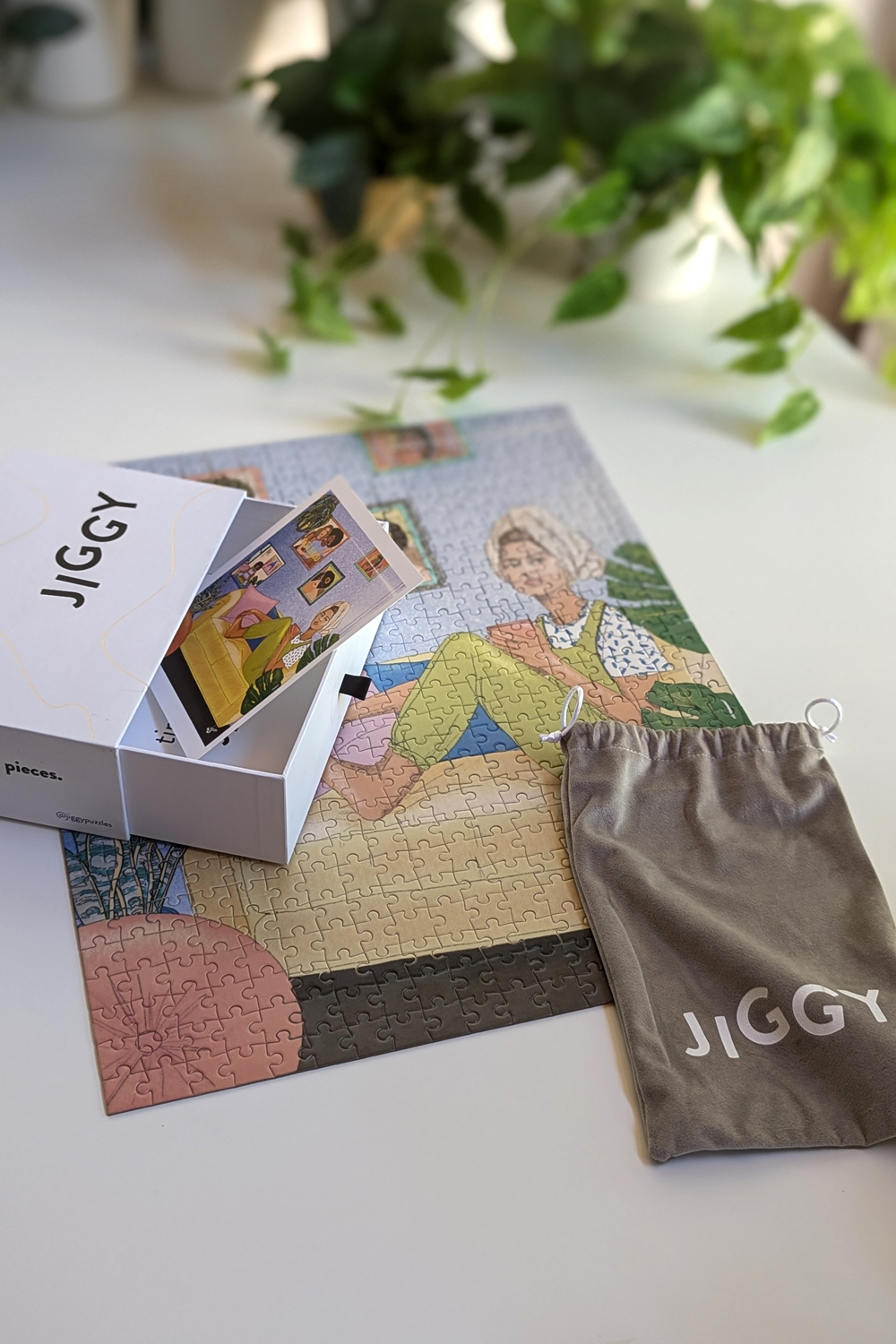
The puzzle that I have and mainly will be reviewing is from their JIGGY Studio puzzle line ($39 for a 500-piece puzzle). The Studio puzzles don’t come quite as kitted out as their Classic puzzles, but they are still presented in a lovely package. Gone are the glass display tubes from the Classic packaging; they instead come in a soft-to-the-touch gray velour drawstring bag branded with the JIGGY logo, which is tucked away in a slip-drawer box. The Studio puzzles also come with the glue, a metal glue spreader, and a small print of the puzzle artwork.

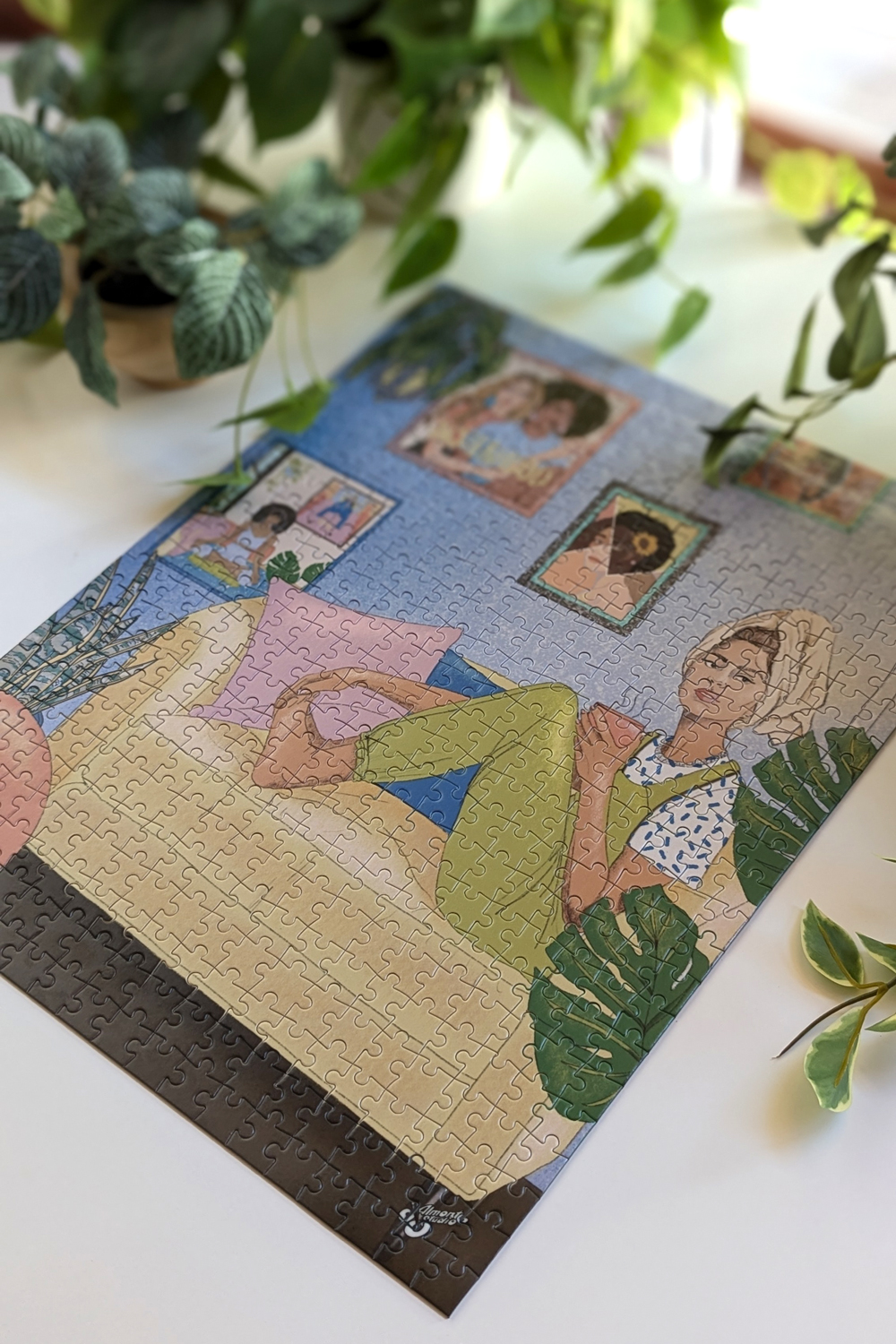
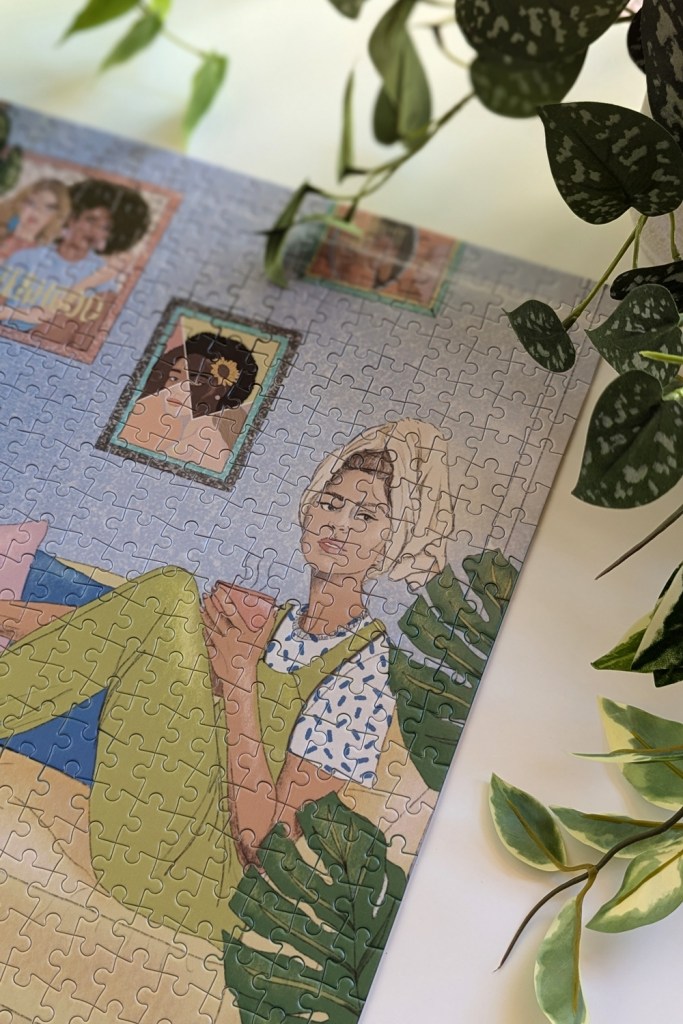
I came across the Studio style puzzle ‘Self Care,’ which features the artwork of Talisa Almonte, at my local Goodwill a couple of weeks ago. I was mostly drawn to the artwork, which shows a woman resting on a couch in a lovely living room setting surrounded by green houseplants. I adored the softer color palette that Almonte chose to use. A bit simplistic, the artwork is just detailed enough that puzzling it wasn’t a chore. I’m very glad that this was a 500-piece design because I don’t think this art would have worked with a larger piece count.
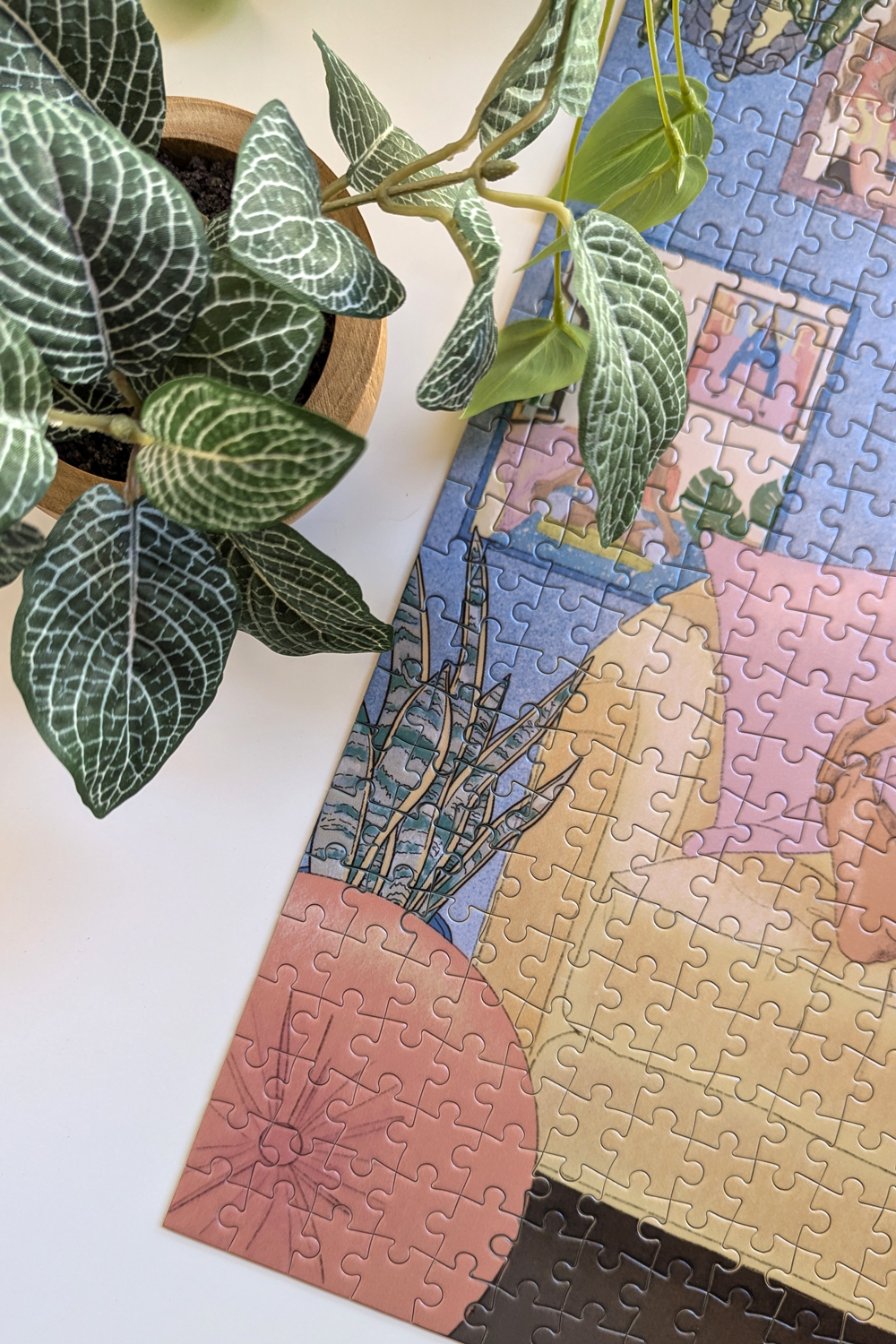
There were a few struggle spots, primarily the larger areas of mostly solid color found on the wall, the couch, and the floor. There was just enough detail provided by the subtle gradient on the wall and the lines of the couch that it wasn’t overly challenging. The floor was thankfully just a small section and it was quite easy to determine which floor piece belonged to which row given that one row was edge pieces, one row had a harsh line where the floor met the couch and the middle row was solid color. Being able to break it down into three distinct rows made it a lot easier to assemble. These sections weren’t a cakewalk, though, for one specific reason that I’ll cover in the quality section of my review.
The rest of the illustration had enough detail, and the different elements were so large that it was relatively easy to finish those parts. I actually liked that there was a little element of spice with the solid color sections because it meant that it took me longer to get through. With 500-piece puzzles, I get a little bit sad if they are so easy that you can simply breeze through them quickly. This puzzle didn’t take much time to complete, especially as my husband joined me for some of it.
Let’s talk Quality.
A quick reminder that this review is for the slightly cheaper JIGGY Studio style puzzles, not the Classic puzzles which come in the glass tubes.
While the packaging for this puzzle is beautiful with its minimal white box, gold foil detailing, and delightfully fuzzy drawstring bag, I was completely underwhelmed by the puzzle itself. The puzzle had paper-backed pieces with a nice branded white underside. The finish on the pieces was smooth but thankfully not too glossy, so glare wasn’t too much of an issue. The thickness and material reminded me quite a bit of a Galison, although the finish itself is nicer and less shiny. It didn’t have the high-end feel or thickness that I would associate with their higher-end pricing. The pieces held together tentatively; while this puzzle would survive the puzzle pickup challenge, moving sections around had to be done carefully, and typically you’d lose a few pieces in the process.
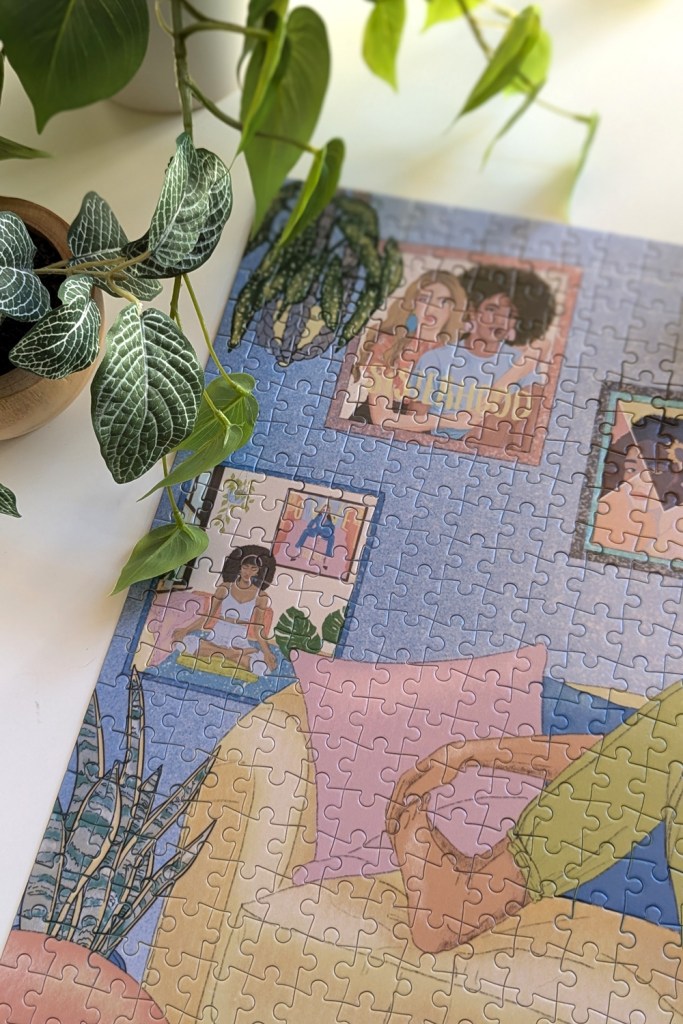
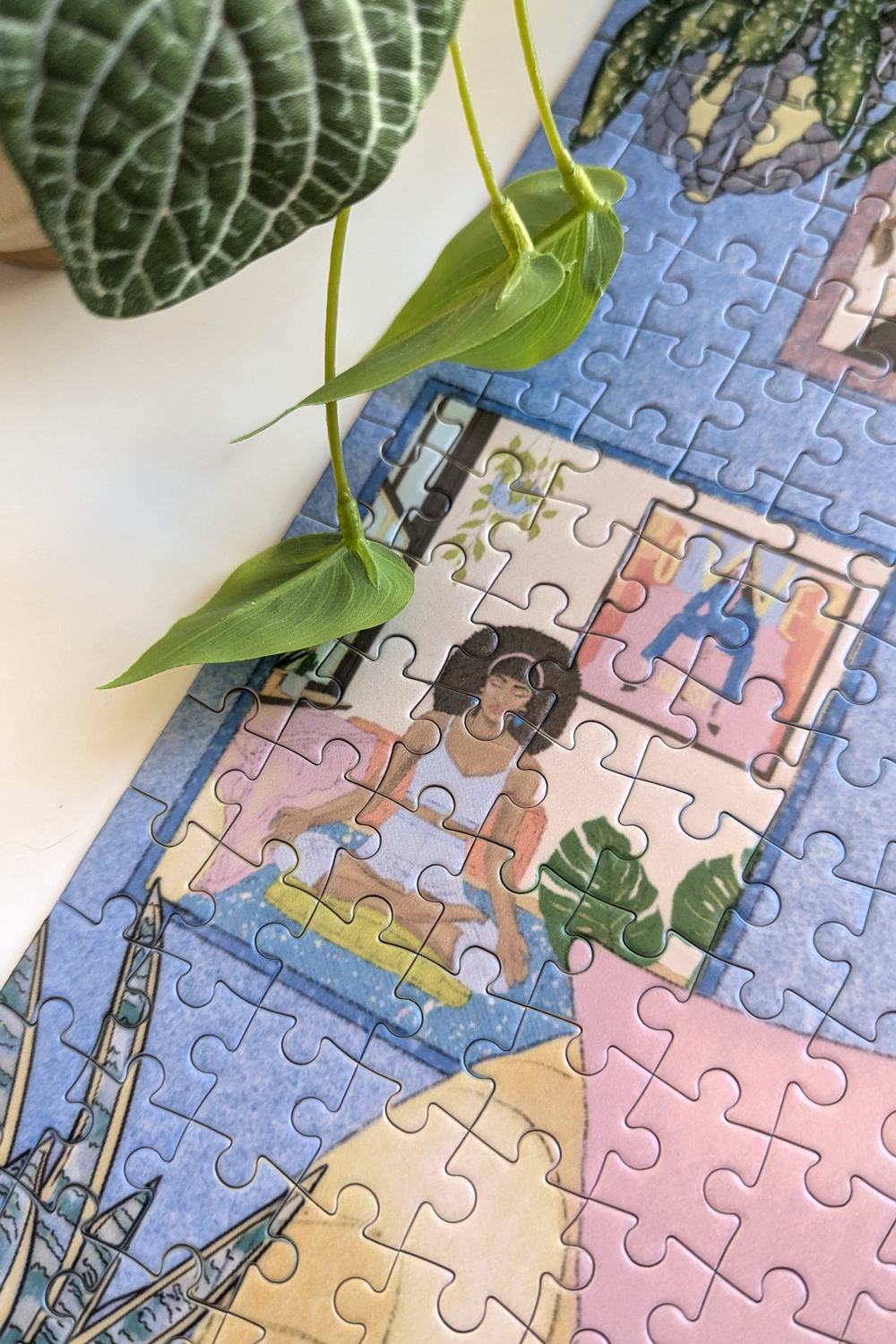
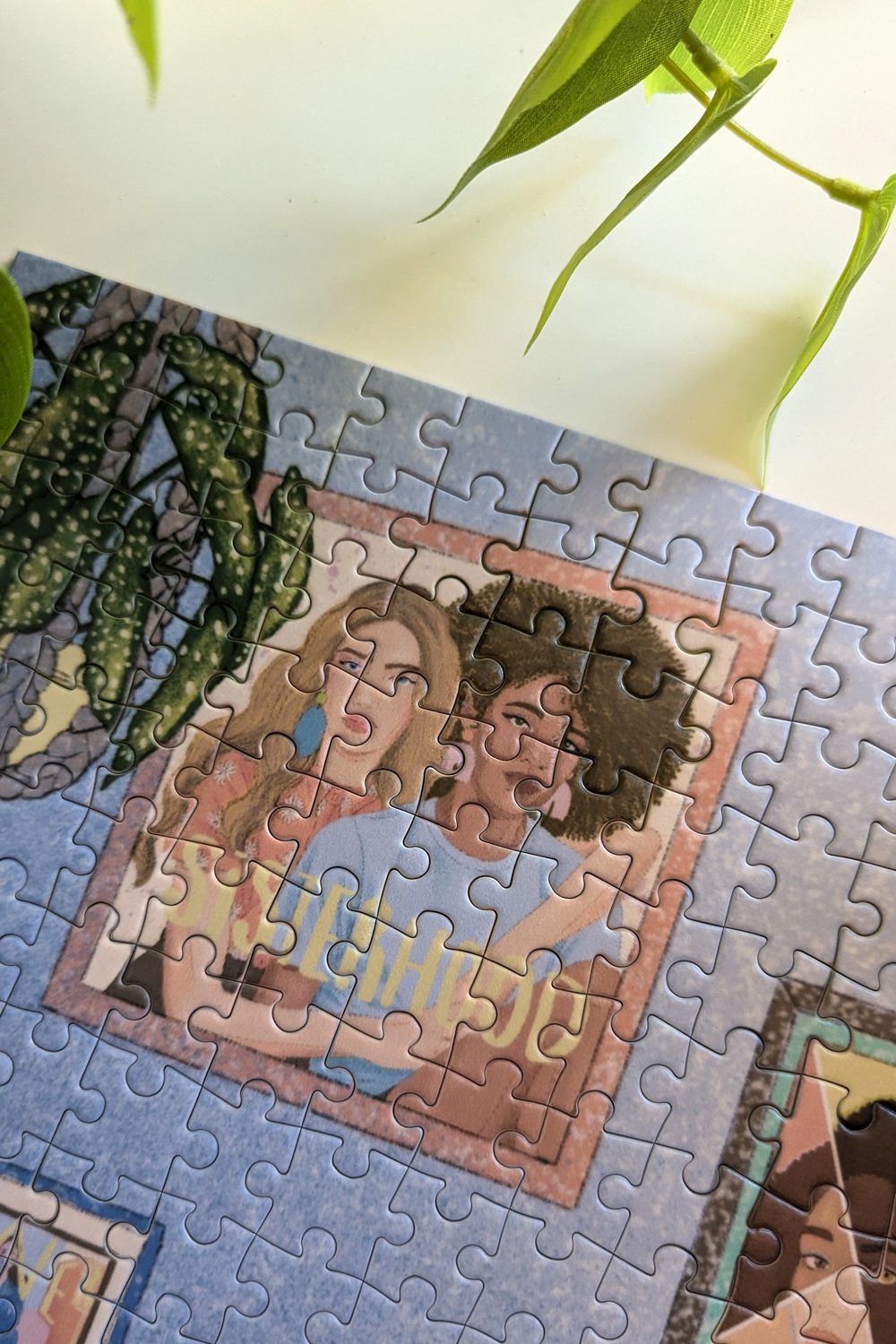
The cut, however, was this puzzle’s downfall. I didn’t mind the simple varied ribbon cut in principle, but it was the shape of each inner and outer prong (or knob, as it’s sometimes called) that I think is the crux of the problem. It’s a little hard to describe, but each prong was very circular in shape, and this particular cut allowed for a staggering amount of false fits. Admittedly, the artwork didn’t help in this respect. While the more detailed sections that I mentioned earlier were relatively easy to put together and only had a few false fits, the simple, more solid areas of color coupled with this cut were borderline frustrating given how many pieces were initially incorrectly placed. My husband and I are seasoned puzzlers, so overall, this was a very easy puzzle for us, but I could see this cut, paired with this artwork, being challenging for a newer puzzler.

One of JIGGY’s selling points is to have puzzles that are good enough to frame once assembled. They have a beautiful selection of artwork on their puzzles. This is lovely in principle, but not every piece of art makes for a good puzzle. They have several designs that, in my opinion, look like they would be a nightmare to put together mixed in among some that look like they would be fun to put together.
You’d really need to take care when choosing the right artwork if you want it to be an enjoyable puzzling experience, especially given the puzzle cut. My suggestions would be to avoid any artwork that has large solid sections of color, repeating patterns, or large abstract areas. I would instead look for designs with a mix of element sizes, distinct color sections, and well-defined elements. Unless you are looking for a challenge. At which point, a good portion of their designs would probably work for you.
The idea that a puzzle is beautiful enough to frame is a lovely one, but in my experience, it’s such a niche branch of people who actually want to frame their puzzles. Quite frankly, I really dislike that JIGGY includes puzzle glue and a glue spreader in each box. It’s so incredibly wasteful. I would be really interested to see the percentage of JIGGY customers who actually frame their puzzles in the end. All I can think about with this brand is the sheer amount of unused glue and metal spreaders that were produced and then just discarded into junk drawers or the trash. It would be so much better if this was an add-on product that you could opt into. Add to that the glass display tubes of the Classic style puzzles. Without a doubt, it is the loveliest way I’ve ever seen to display a puzzle, but I can only imagine the amount of damaged product that happens in shipping and then the added environmental factor of having to produce the glass containers and the increased weight for shipping. Now, JIGGY does have carbon-neutral shipping, and that certainly can be a plus, but without knowing who they work with to offset or remove their portion of carbon, it’s hard to say this isn’t just a bit of greenwashing.
So, are JIGGY Studio style puzzles worth the high $39 price? In my opinion, no. If you are looking for a stylish gift for a puzzler and are looking for something that looks impressive, then it’s a very hesitant maybe. The packaging does look impressive, and it makes for a very lovely gift, but you would certainly be paying up for the nice presentation of a subpar puzzle.
In the words of Paul Hollywood, this puzzle was “Style over Substance”. I loved the artwork but just can’t justify that higher end price with the lower quality of the puzzle. Frankly, I was shocked that the cut design was so poor. Beyond the cut, the thickness of the backer and the finish maybe added up to a $18-25 puzzle at most. You truly are paying a lot for the fancy packaging and extras on this one. If framing the puzzle was really an important factor for you then and you did love the artwork then maybe I could see someone finding it worth the price. I do think that the majority of designs are going to make for less enjoyable experiences with that puzzle cut. I would rather spend $39 on just buying a nice print of the artwork rather than trying to force it into a puzzle design.
Have you tried a JIGGY puzzle? Do you think it’s worth the $39 starting price? Let me know in the comments!
Links & Details
Looking to put this puzzle together? You can buy Self Care, the 500-piece JIGGY puzzle here.
Brand: JIGGY
Title: Self Care
Pieces: 500
Artist: Talisa Almonte


Leave a Reply